Stealth Technology Group Team


Every application your employees use, every transaction your systems process, every file your team collaborates on, and every security control protecting your organization’s data depends on one thing functioning correctly beneath it: your network infrastructure. When that foundation is well-designed, well-managed, and appropriately scaled, it is invisible — a seamless, reliable environment where technology simply works. When it is not, its failure is impossible to ignore: slow application response times that sap productivity, connectivity interruptions that disrupt client-facing operations, security gaps that expose sensitive data to threat actors, and cascading failures that reveal just how deeply every business process depends on the network beneath it.
For most small and mid-sized businesses, network infrastructure has grown organically rather than by design. A switch was added when the office expanded. A second wireless access point was installed when Wi-Fi coverage fell short in the conference room. A VPN was set up when remote work became necessary. Security appliances were bolted on when a compliance requirement demanded it. The result is an infrastructure that reflects the history of the business rather than a coherent architecture — and that gap between what was installed and what the organization actually needs shows up as performance problems, security vulnerabilities, and operational bottlenecks that frustrate staff and constrain growth.
This article examines what network infrastructure actually consists of, how each layer contributes to business performance and security, what the most common failure points are in SMB network environments, how the architecture of the modern network has evolved with the rise of cloud services and distributed work, and what a proactive, managed approach to network infrastructure looks like in practice. Whether you are evaluating your current environment against what it should be, planning a network refresh, or simply trying to understand why your current setup is underperforming, the framework that follows provides a foundation for making better infrastructure decisions. Our detailed guide to network infrastructure planning goes deeper on the design methodology; this article gives you the strategic context to put those decisions in perspective.

What Network Infrastructure Actually Consists Of
The term “network infrastructure” encompasses every physical and logical component that enables communication between devices, systems, users, and external services within and beyond your organization. According to Gartner, IT infrastructure is the composite hardware, software, network resources, and services required to operate an enterprise’s IT environment — and the network layer is the connective tissue that holds all of it together. Understanding what the network consists of is the prerequisite for understanding how to manage it, what to invest in, and where problems originate when they arise.
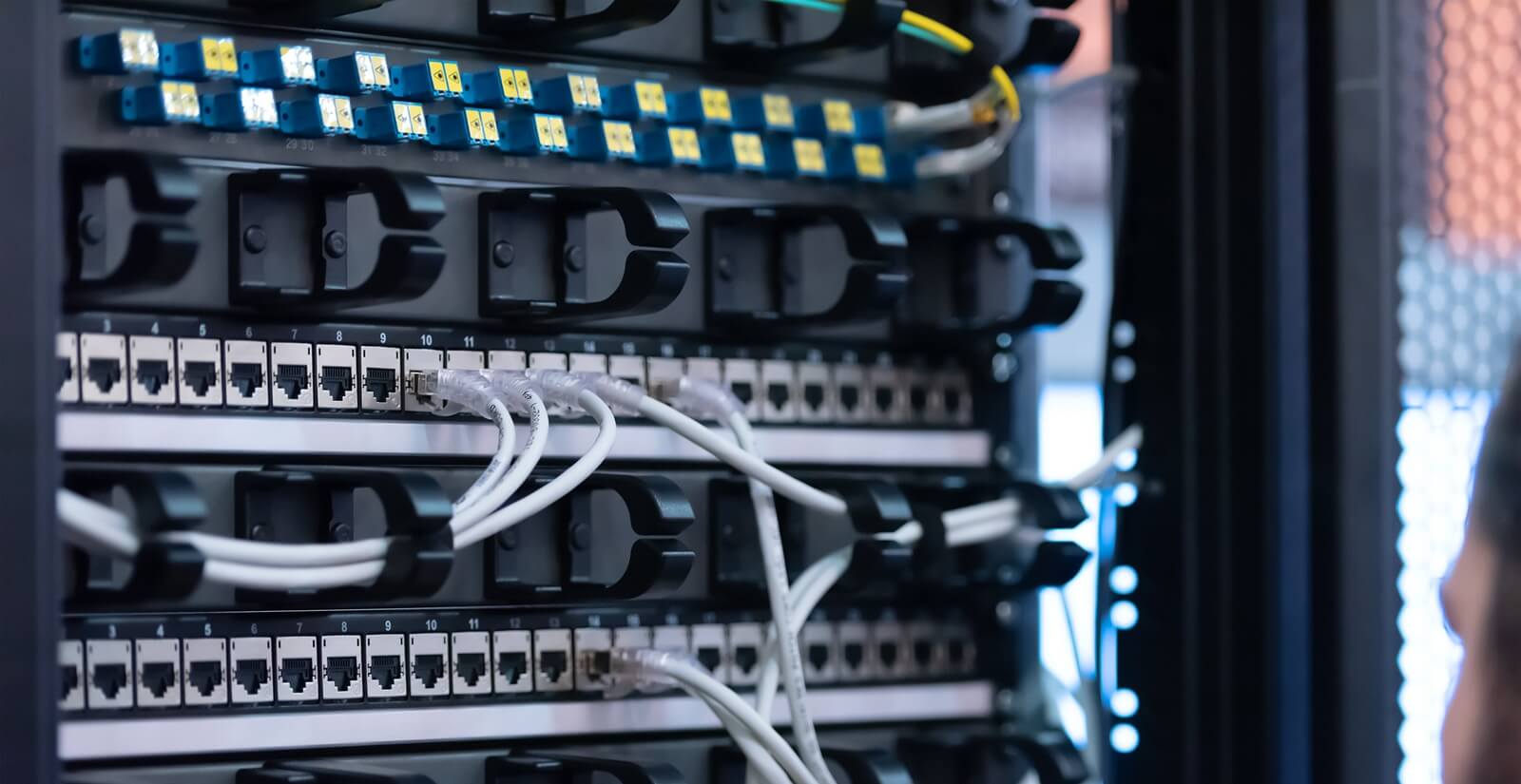
At the physical layer, network infrastructure begins with the cabling that connects devices — structured cabling systems using Cat6 or Cat6A copper for workstation connections, fiber optic backbone cabling between network closets and between floors, and the patch panels and cable management systems that organize physical connections into a maintainable, documented topology. The quality and organization of physical cabling has a direct bearing on network performance and troubleshooting speed: well-documented, cleanly installed cabling reduces the time and cost of moves, adds, and changes, while unmanaged cable plants create fault-finding challenges that consume technician hours disproportionate to the underlying issue.
Switching infrastructure forms the foundation of local area network communications, directing traffic between devices within the same network segment with switching decisions made at wire speed. Managed switches — those with configurable port settings, VLAN support, quality-of-service controls, and monitoring capabilities — are the appropriate choice for any business environment because they provide the visibility and control that unmanaged switches cannot. An unmanaged switch forwards traffic without discrimination or insight; a managed switch lets you segment traffic between departments, prioritize latency-sensitive applications like voice over IP, monitor port utilization, and detect anomalous traffic patterns that may indicate a security incident.
Routing infrastructure controls how traffic moves between different networks — between your internal network segments, between your on-premises environment and the internet, and between your primary location and branch offices or cloud platforms. The router at your internet boundary is the gateway through which all external traffic passes, and its configuration — access control lists, NAT policies, routing protocols, and security features — has a direct bearing on both performance and security. Next-generation firewalls that combine routing with deep packet inspection, application-layer filtering, and intrusion prevention are the current standard for internet boundary devices in business environments, replacing the simple stateful inspection firewalls of earlier generations. Our analysis of firewall management services covers what proper management of this boundary device requires.
Wireless network infrastructure has grown from a convenience feature to a primary access layer in most business environments. Laptops, tablets, smartphones, VoIP handsets, IoT devices, and increasingly even desktop workstations connect via wireless rather than wired Ethernet in modern office environments. Enterprise-grade wireless infrastructure — access points from vendors such as Cisco Meraki, Aruba, or Ubiquiti managed through a centralized controller — differs from consumer or small-office wireless equipment in its support for multiple SSIDs with different security policies, seamless roaming between access points, radio frequency management that optimizes coverage and minimizes interference, and detailed analytics on client connections and usage patterns.
The Most Common Network Infrastructure Failures in SMB Environments
Understanding what typically goes wrong with network infrastructure in small and mid-sized business environments is the first step toward building something better. The failure patterns that Stealth Technology Group’s engineers encounter most frequently when assessing new client environments fall into several predictable categories that, once identified, are entirely addressable through proper design and managed IT services.
Flat network architecture — where all devices, from executive workstations to network printers to guest Wi-Fi clients, exist on the same logical network segment — is the most prevalent structural failure in SMB network environments. A flat network means that any device that gains network access can communicate directly with any other device without traversing a controlled boundary.
The security implications are severe: a compromised laptop can scan and attack file servers, a guest network visitor can attempt connections to internal systems, and ransomware that infects one endpoint can spread laterally across the entire address space without encountering a firewall policy that would slow its progress. VLAN segmentation that separates device categories — servers, workstations, wireless clients, guests, and management systems — into separate network segments with controlled inter-segment traffic is the architectural correction, and it is achievable on any modern managed switching infrastructure.
Aging or undocumented infrastructure is the second most common failure pattern. Network equipment that has reached end of life no longer receives security patches from the manufacturer, exposing known vulnerabilities that threat actors actively scan for and exploit. Switches, routers, and firewalls from vendors who have discontinued the product line may be running firmware with unpatched critical vulnerabilities.
The absence of current network documentation — accurate topology diagrams, IP address management records, VLAN assignments, and configuration backups — means that troubleshooting takes longer, changes carry higher risk of misconfiguration, and the institutional knowledge of how the network is built exists only in the memory of whoever set it up. IT infrastructure managed services that include configuration management and documentation maintenance address both the technical and organizational dimensions of this failure pattern.
Wireless coverage and capacity problems represent a third category of common failure. Consumer-grade wireless equipment deployed to save cost in a business environment lacks the RF management capabilities to handle the device density of a real office, does not support enterprise authentication methods that tie wireless access to individual user identities, and provides no visibility into the wireless environment that would enable troubleshooting or capacity planning. Wireless networks that run without centralized management also cannot enforce consistent security policies across all access points, creating coverage and policy gaps that users work around by connecting to unsanctioned networks or by disabling security controls that impede their work.
Network Segmentation and Security: Why Your Network Architecture Is a Security Control
Network architecture is not just a performance consideration — it is one of the most important security controls in your environment. The way your network is designed determines which devices can communicate with which other devices, how far a threat actor or piece of malware can move laterally after gaining an initial foothold, and how effectively your security tools can monitor and control traffic flows. Zero trust network architecture — the principle that no device, user, or connection should be trusted implicitly based on network location — represents the current best-practice framework for network security design, and its core principles are achievable in SMB environments without enterprise-scale budgets.
Network segmentation through VLANs is the practical implementation of zone-based security in a business network. By placing different categories of systems in separate VLANs — a server VLAN, a workstation VLAN, a management VLAN for network devices, a wireless VLAN for corporate devices, a guest VLAN for visitor access, an IoT VLAN for printers, cameras, and building systems — you create a network architecture where inter-segment traffic must traverse a firewall or access control policy rather than flowing freely. This means that a workstation infected with ransomware cannot directly access file server shares without generating traffic that passes through a firewall policy, giving your security controls an opportunity to detect and block the lateral movement attempt.
Micro-segmentation takes this principle further by applying access controls at the workload level rather than the network segment level — ensuring that individual servers and applications only accept connections from the specific sources that have legitimate reasons to connect, regardless of which network segment those sources occupy. For regulated businesses handling Protected Health Information, Controlled Unclassified Information, or financial data, micro-segmentation limits the blast radius of any security incident to the specific systems involved, rather than allowing an attacker to pivot from a compromised endpoint to every system reachable on the same network. This segmentation discipline connects directly to the network security controls that Stealth Technology Group implements across client environments — and to the CMMC compliance requirements that mandate specific network architecture controls for defense contractors handling CUI.
Firewall policy management is the operational discipline that makes segmentation effective over time. A firewall policy that was correct when it was written drifts toward non-compliance as new systems are added, business processes change, and temporary rules accumulate without cleanup. Rules that were created to allow a specific application during a project are never removed when the project ends. Overly permissive rules are left in place because tightening them requires analysis that no one prioritizes. Managed firewall services that include regular rule reviews, policy optimization, and change management processes maintain the effectiveness of your segmentation architecture over time rather than allowing it to degrade.

SD-WAN and WAN Connectivity: Connecting Multiple Locations Without Sacrificing Performance or Security
Organizations with multiple locations face connectivity challenges that single-site businesses do not encounter: how to connect branch offices, remote facilities, or home workers to centralized systems reliably and securely, while managing the cost and complexity of wide area network connections. Software-Defined Wide Area Networking (SD-WAN) has emerged as the dominant architecture for multi-site WAN connectivity in SMB and mid-market environments, replacing or augmenting the MPLS private circuits that previously represented the only enterprise-grade WAN option.
Traditional MPLS circuits provide guaranteed bandwidth and predictable latency between connected sites, but at a significant per-site cost and with long provisioning lead times that create agility constraints when business needs change. SD-WAN addresses these limitations by abstracting the WAN transport layer from the underlying physical connections, allowing traffic to be intelligently routed across multiple internet connections — broadband, fiber, LTE, or 5G — with dynamic path selection that optimizes for the application and current link conditions. A real-time voice call is routed over the lowest-latency available path; a large file backup is routed over the highest-bandwidth available path; if one connection fails, traffic automatically shifts to the remaining connections without intervention.
For businesses with distributed teams or multiple office locations, SD-WAN provides a meaningful combination of performance improvement and cost reduction relative to MPLS-only architectures. The security capabilities integrated into modern SD-WAN platforms — encrypted tunnels between all sites, centralized security policy enforcement, application-aware traffic steering that prevents shadow IT applications from consuming bandwidth reserved for business-critical traffic — make SD-WAN a security improvement as well as a connectivity upgrade. When combined with cloud-based VoIP that runs over the same SD-WAN infrastructure with QoS policies that protect voice quality, the result is a unified communications and connectivity architecture that supports distributed teams without the complexity of managing separate voice and data networks.
The shift to cloud services has fundamentally changed WAN traffic patterns in ways that traditional hub-and-spoke WAN architectures handle poorly. When most application traffic was destined for on-premises data centers, routing all traffic through a central hub made sense. When Microsoft 365, Salesforce, and dozens of other cloud applications are the primary destinations, routing all traffic through a central hub before breaking out to the internet adds latency for no benefit. Cloud transformation initiatives that move workloads to cloud platforms should therefore be accompanied by WAN architecture reviews that ensure traffic can reach cloud destinations efficiently from each location, rather than carrying the latency penalty of unnecessary hub routing.
Wireless Network Design: Moving Beyond Access Points in the Ceiling
Wireless network performance problems are among the most persistent and most frustrating infrastructure complaints in modern office environments, and they are almost always the result of design decisions made without adequate RF planning or capacity analysis. The evolution toward Wi-Fi 7 — with its multi-link operation, 320 MHz channel widths, and improved handling of dense device environments — offers meaningful performance improvements for high-density office environments. But wireless performance problems are rarely solved by upgrading access point hardware alone; they are typically solved by addressing the underlying design decisions that created the problems in the first place.
Wireless site surveys are the foundation of effective enterprise wireless network design. An RF site survey maps the physical environment — wall materials, ceiling heights, interference sources, and existing wireless signal characteristics — and uses this data to determine optimal access point placement, antenna orientation, transmit power settings, and channel assignments. Access points placed based on visual judgment rather than RF analysis frequently create coverage holes in unexpected locations, co-channel interference between adjacent access points on the same channel, and capacity bottlenecks where too many clients associate with a single access point when a better-placed alternative would distribute the load more effectively.
Enterprise wireless authentication should use WPA3-Enterprise with 802.1X authentication rather than the pre-shared key authentication used in home and small-office wireless networks. Pre-shared key authentication uses a single password shared by all users; if that password is compromised, every device that knows it can access the wireless network, and the only remediation is changing the password everywhere simultaneously. 802.1X authentication ties wireless access to individual user identities — Active Directory credentials, certificate-based authentication, or both — so that access can be granted or revoked per user, access events are attributable to specific individuals, and a compromised credential affects only the user whose credential was compromised.
Separate wireless SSIDs for different trust levels are a practical necessity in any business environment. Corporate devices connecting to business applications should be on a separate SSID from guest devices connecting for internet access. IoT devices — printers, cameras, smart TVs in conference rooms, building control systems — should be on a dedicated IoT SSID that connects to a segmented network with no access to corporate systems. These segmentation decisions are architectural and must be made at the design stage; bolting them on to an existing flat wireless network requires significant reconfiguration. Stealth Technology Group’s managed monitoring services maintain continuous visibility into the wireless environment after deployment — tracking client associations, channel utilization, and interference events that indicate wireless performance degradation before users notice it.
Server and Data Center Infrastructure: On-Premises, Cloud, and Hybrid
The server infrastructure that hosts your business applications, file storage, and identity services is the destination for most network traffic and the component whose failure causes the most immediate and broadly felt operational impact. The right infrastructure model — fully on-premises, fully cloud, or hybrid — depends on factors including the applications you run, your regulatory environment, your bandwidth, and your recovery time requirements. What is consistent across all models is the need for proactive management that prevents failures rather than responding to them.
On-premises server infrastructure requires active lifecycle management to avoid the performance degradation and security risk that accumulates in aging hardware running unsupported software. Server hardware that has exceeded the manufacturer’s warranty period carries elevated risk of component failure; storage arrays with degraded drives are operating without the redundancy that protects against data loss; operating systems past their end-of-support date no longer receive security patches. Server health monitoring that tracks hardware component status, resource utilization trends, and software patch currency provides the visibility needed to identify and address these risks before they result in unplanned outages.
Cloud infrastructure management requires a different discipline but is equally demanding. The ease of provisioning cloud resources creates a tendency toward sprawl — virtual machines, storage accounts, and services that were created for a specific purpose and never decommissioned, accumulating cost and potential security exposure without delivering ongoing value. Managed cloud IT services that include cloud cost optimization, configuration governance, and security posture management address cloud infrastructure with the same rigor that on-premises infrastructure management applies to physical hardware and software.
The hybrid infrastructure model — combining on-premises systems with cloud platforms — introduces integration complexity that must be managed deliberately. Identity federation that allows on-premises Active Directory users to authenticate to cloud services without separate cloud credentials, network connectivity between on-premises and cloud environments through VPN or ExpressRoute connections, and data synchronization that keeps information consistent across environments all require active management. IT infrastructure managed services that span both on-premises and cloud environments provide the unified visibility and management capability that hybrid infrastructure requires.
Network Monitoring and Observability: You Cannot Manage What You Cannot See
The most common characteristic of network infrastructure problems that escalate into outages is that they were visible in monitoring data before the outage occurred — and nobody was watching. Interface error rates climbing on a switch uplink port. Disk latency increasing on a file server as a failing drive degrades. CPU utilization on a firewall creeping upward as a configuration issue causes packet processing to consume more resources than expected. These trends announce themselves in monitoring data before they become failures, and managed monitoring services that alert on these trends give operations teams the opportunity to intervene before users experience the impact.
Network monitoring encompasses several distinct data streams that together provide comprehensive visibility into infrastructure health and performance. SNMP polling of network devices collects interface statistics, CPU utilization, memory usage, and device health data at regular intervals. NetFlow or sFlow data from routers and switches provides traffic analytics that show which applications and users are consuming bandwidth, which connections are established between which endpoints, and which traffic patterns are anomalous relative to the established baseline. Syslog collection from all network devices captures configuration changes, authentication events, and error conditions that are invisible to performance monitoring tools.
Security monitoring overlaps with but is distinct from performance monitoring. Security event logs from firewalls, endpoint protection tools, authentication systems, and cloud platforms must be collected, correlated, and reviewed to detect intrusion attempts, policy violations, and anomalous behavior that indicates a security incident in progress. The volume of security event data generated by a modern business environment makes manual review impractical without a SIEM platform that correlates events across sources and surfaces the conditions that warrant human attention. Remote infrastructure managed services that include 24/7 security monitoring provide the continuous coverage that most SMB environments cannot maintain with internal staff alone — and connect directly to the cybersecurity services layer that acts on what monitoring detects.
Network Infrastructure and Business Continuity: Planning for When Things Go Wrong
Network infrastructure failure is one of the most impactful categories of business disruption because it can render all other systems simultaneously unavailable. A core switching failure that segments the network. An internet circuit failure that disconnects remote workers and cloud-dependent applications. A firewall failure that takes down both connectivity and security simultaneously. Business continuity planning for network infrastructure requires identifying single points of failure and introducing redundancy where the cost of failure justifies the investment in redundant components. Disaster recovery testing that specifically validates network recovery procedures — not just server and data restoration — ensures that network failover capabilities function as designed when they are actually needed.
Internet connectivity redundancy is one of the most cost-effective business continuity investments available to SMB organizations. Dual internet circuits from different providers — ideally using different physical paths and different access technologies — eliminate the internet as a single point of failure for cloud-dependent operations. When the primary circuit fails, traffic automatically shifts to the secondary circuit with minimal disruption. The monthly cost of a secondary internet connection is almost always far less than the hourly cost of an internet outage for a business that depends on cloud services and remote connectivity. This redundancy pairs directly with backup and data recovery services that ensure the data layer recovers as effectively as the network layer after any disruption.
Network configuration backups are a frequently overlooked element of network business continuity. When a router, switch, or firewall fails and must be replaced, the time required to restore the device to its operational configuration — from memory, from notes, or from a configuration file that may or may not be current — directly extends the outage. Automated configuration backup processes that capture device configurations on a defined schedule and store them in a secure, accessible repository mean that replacement hardware can be configured quickly and correctly, minimizing restoration time. This is exactly the kind of operational discipline that benefits of the managed services model deliver systematically, rather than depending on individual technicians to remember to perform it manually.
Network Infrastructure for Remote and Distributed Work
The widespread adoption of hybrid and remote work arrangements has extended the effective perimeter of business network infrastructure to include residential broadband connections, coffee shop Wi-Fi, and cellular networks that organizations do not own, manage, or trust. The security and performance implications of this extension are significant and require deliberate architectural responses. Protecting sensitive data in remote and hybrid work environments requires treating remote connections as untrusted by default — the zero trust principle applied to the WAN boundary — and designing remote access architectures that enforce security controls regardless of where the user connects from.
VPN architecture for remote access has evolved significantly from the early days of site-to-site IPSEC tunnels. Modern remote access VPN solutions use always-on VPN clients that connect automatically when a device leaves the corporate network, ensuring that security controls and monitoring are active regardless of the connection source. Split tunneling configurations can be designed to route corporate traffic through the VPN while allowing internet traffic to break out locally, improving performance for cloud application access while maintaining policy enforcement for traffic destined for corporate systems.
For organizations with internal IT staff who manage some network functions, a co-managed IT arrangement that provides remote infrastructure support, security monitoring, and escalation capability gives internal teams the backing they need for complex network issues without requiring them to be experts in every infrastructure domain. And for organizations looking to align their network infrastructure investment with longer-term business strategy — planning for growth, evaluating cloud migration timing, or assessing the network implications of new office locations — vCIO services provide the strategic technology leadership to make these decisions with confidence rather than improvising them reactively.
The NIST Framework and Network Infrastructure: Building Compliance Into Your Architecture
For businesses operating in regulated industries or pursuing federal contracting opportunities, network infrastructure is not just an operational consideration — it is a compliance requirement. The NIST Cybersecurity Framework organizes security controls across five functions — Identify, Protect, Detect, Respond, and Recover — and network infrastructure contributes meaningfully to every one of them. Network asset inventory satisfies Identify requirements. Network segmentation and access control satisfy Protect requirements. Network monitoring and anomaly detection satisfy Detect requirements. Network failover and redundancy satisfy Recover requirements. Building network infrastructure with these requirements in mind from the design stage is far more cost-effective than retrofitting compliance controls onto an existing architecture.
For defense contractors specifically, CMMC Level 2 includes network-specific requirements drawn from NIST SP 800-171: network boundary protection controls, CUI system isolation from non-CUI systems, monitoring of external and internal network communications, and controls on remote access connections. These requirements have direct implications for network architecture decisions — which systems are on which VLANs, how internet boundary devices are configured, what remote access methods are permitted, and how network traffic to and from CUI systems is logged. Stealth Technology Group’s CMMC compliance services integrate network architecture review as a core component of CMMC readiness assessment, ensuring that the network layer of your environment satisfies the requirements that assessors will examine.
Organizations in Boston, Tampa, and Sarasota across healthcare, financial services, legal, engineering, and defense contracting verticals face varying regulatory requirements, but the underlying network architecture principles that satisfy those requirements are consistent: documented topology, segmented network zones, controlled boundary devices, monitored traffic flows, and redundant critical paths. Stealth Technology Group serves businesses across Boston, Tampa, and Sarasota with network infrastructure services designed to meet both the operational demands of each industry and the regulatory requirements that apply to it.

Conclusion: Network Infrastructure Is Not a Cost — It Is the Platform Your Business Runs On
Every productivity tool, every cloud service, every security control, and every communication system your organization depends on runs on top of your network infrastructure. When that infrastructure is well-designed, proactively managed, and appropriately scaled for your business, it is invisible — and that invisibility is exactly what good infrastructure looks like. When it is inadequate, aging, or unmanaged, it makes itself known in the most disruptive and inconvenient ways possible. Fully managed IT services that include network infrastructure as a first-class management responsibility — not a background concern addressed only when something breaks — are the foundation of operational stability for businesses that depend on technology to serve their clients and run their operations.
The businesses that treat network infrastructure as a strategic asset rather than a maintenance burden gain real competitive advantages: faster application performance that improves employee productivity, stronger security posture that reduces breach risk and supports compliance, reliable connectivity that enables remote and distributed work without degradation, and the operational confidence that comes from knowing your technology foundation has been built to hold up under the demands you place on it.
Build a Network Infrastructure That Works As Hard As Your Business Does Stealth Technology Group designs, deploys, and manages network infrastructure for businesses across Boston, Tampa, and Sarasota — from structured cabling and enterprise switching to SD-WAN, wireless network design, firewall management, 24/7 monitoring, and CMMC-aligned network security architecture. We work with organizations across healthcare, legal, financial services, engineering, and defense contracting to build network foundations that are reliable, secure, compliant, and scalable. If your network was built to get you where you are rather than where you are going, it is time to have a conversation about what it should look like. 📞 Boston: (617) 903-5559 📞 Tampa: (813) 578-8740 📞 Sarasota: (941) 259-1737.